


I wasn’t sure where to file this—photography, holiday pitch, or business update. Honestly, it covers over the cracks between all three.
Just finished a restful Shabbat, and tomorrow morning it’s back into the hives early to check the bees, pull frames, and lug in the heavy lifting for extraction this week. People see the finished product, but they rarely see the sweaty, hard physical labor that comes before it.
Eventually, all that work lands on the kitchen table.
With Rosh Hashanah coming up, Neshika co-founder Chaya Ben-Baruch and her daughter Keren are finishing up the packaging on our Neshika lip balms. Keren has Down Syndrome, and that’s simply part of how we run things here—no big marketing campaign about inclusion, just real life and daily work.
Every autumn brings its own rhythm, but in the weeks leading up to the Rosh Hashanah, the Jewish New Year, the work takes on a particular weight. Honey isn't just a harvest here; it’s an intent to be blessed and savored at family tables.
At this table at Beit Neshika here in Tzfat, in northern Israel, sit Chaya Ben-Baruch and her daughter, Keren. Their task is deceptively simple: sorting, labeling, and packing Neshika lip balms. Tubes of beeswax, honey, and natural oils prepared in the kitchen next door pass between hands that have worked together for decades. Keren has Down Syndrome, and that fact isn't tucked away or treated as a side note—it is central to who we are. Inclusion isn't a campaign for Neshika; it’s baked directly into the fabric of the daily work.
To capture this without slipping into cheap nostalgia requires deliberate technical choices—and an appreciation for managing the harsh, unyielding western light of a late Mediterranean afternoon.
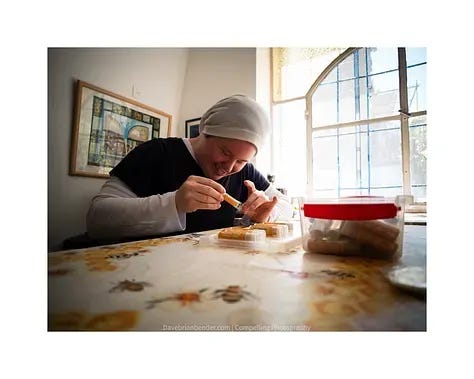
Imaging: The Work in Motion
Eye-level perspective shifts the narrative from mechanical process to human connection. Framing Chaya in the immediate foreground creates a natural depth-of-field anchor, pulling the viewer straight to Keren’s expression across the table.
It was a strong, unforgiving afternoon light cutting through the window, but it set off their faces beautifully. It introduced a natural chiaroscuro—a concept my wife Miri often points to in our arts video series, and one I've increasingly adopted in my own work. The goal wasn't to produce something bright, sunny, and polished, but to give room to the darkness to speak. By letting the shadows hold their ground, the soft tonalities between light and deep shadow do the heavy lifting.
Underexposing with the S26 Ultra’s Expert RAW capture allowed for maximum dynamic range across that harsh contrast—holding the highlight details on Keren's face while preserving the rich, deep tones under the table.
Shadow, Form, and Texture
Dropping down to eye level gives you the human side. Framing Chaya in the foreground anchors the shot and pulls you straight across to Keren.
That strong side-light gave us a heavy, natural chiaroscuro—something my wife Miri always pushes me toward. The temptation is always to make things bright, sunny, and commercial, but I wanted to give room to the darkness. The real tonality lives in the shadows.
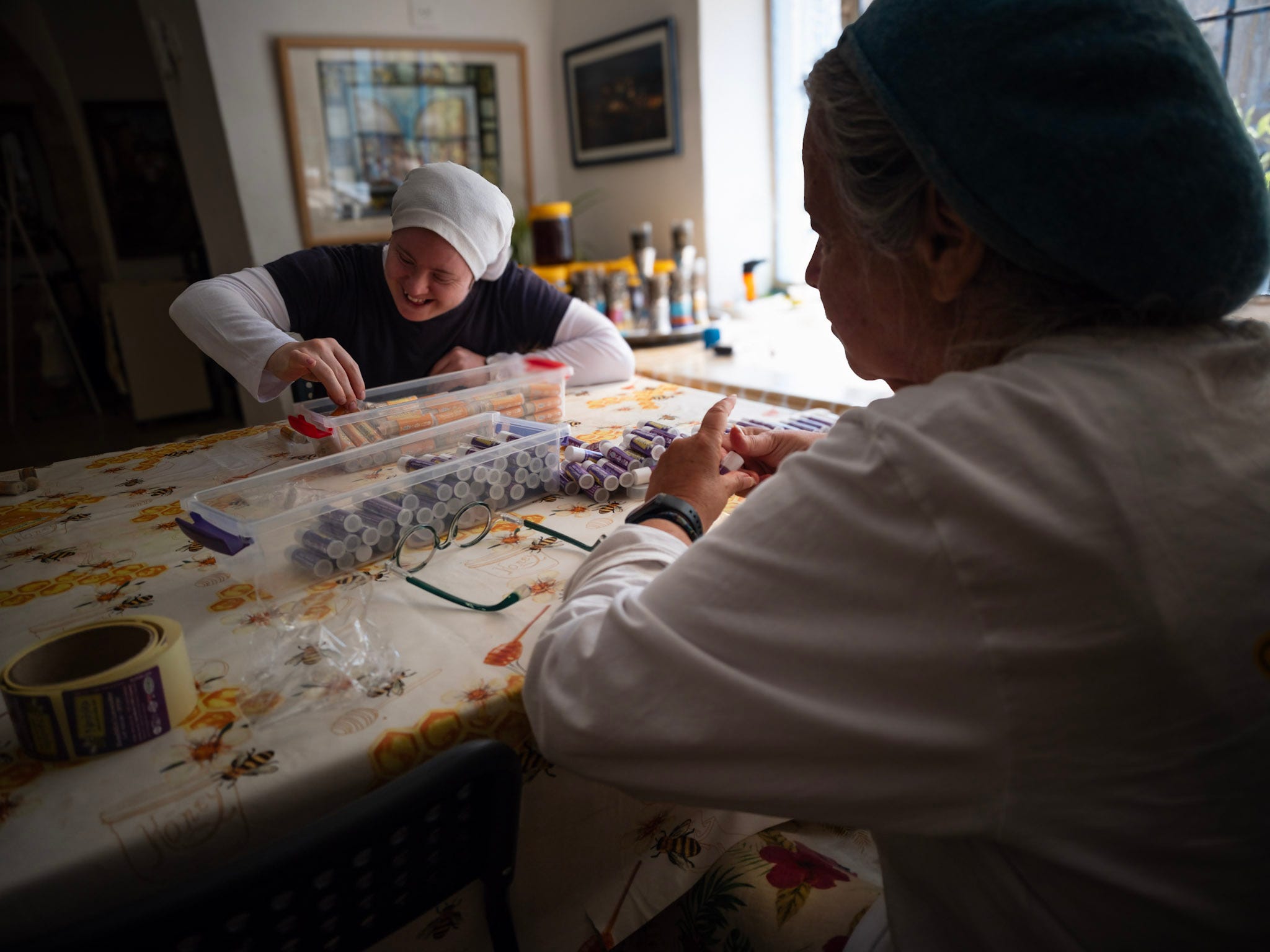

Stripping away color entirely forces the eye to focus purely on form, light, and subject. A monochrome conversion relies entirely on mid-tone separation.
After decades behind the camera, you build a workflow that fits like an old glove. I love building custom Leica and Hasselblad presets, but for me, a preset is always—always—just the starting point. The real work happens in the manual tweaking afterward: carving out the light, sculpting the mid-tones, and digging for the soul of the composition.
The digital equivalent of dodging and burning in the darkroom.
There is an immensely satisfying pleasure in taking a flat, two-dimensional sensor read and forcing three-dimensional humanity out of it—showing people’s souls active in a craft they love, creating something we love for Neshika.
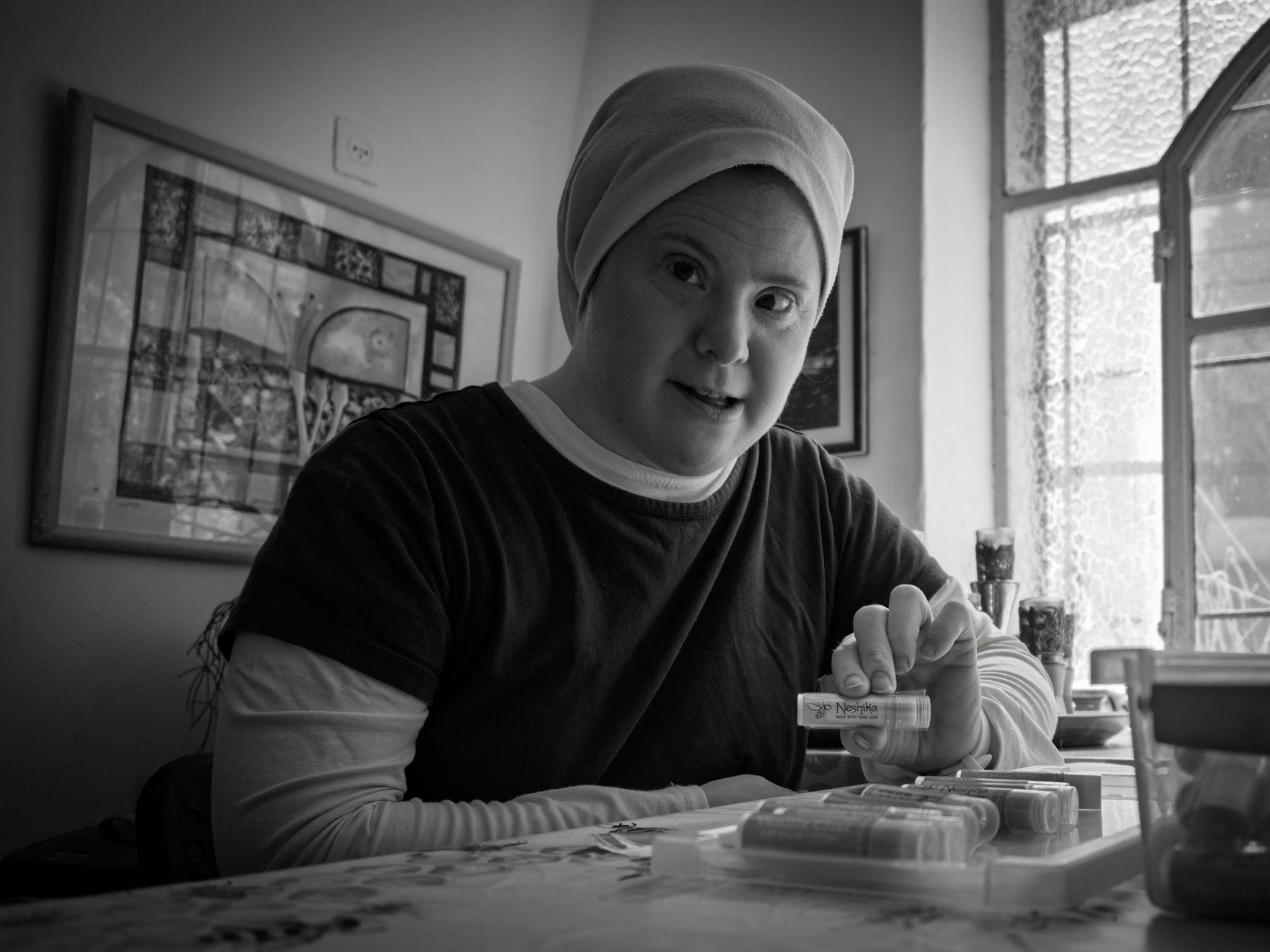
Here, Keren holds up a single finished tube of balm—a small object against the intense backlight of the window. The strong side-lighting threatened to blow out the frame, but local shadow recovery and precise curve adjustments brought out the quiet confidence in her face without sacrificing the depth of the shadows around her.
The Overhead Dynamics
I shot these on the S26 Ultra in Expert RAW. I like shooting directly overhead here because it flattens the frame and turns the table into a working canvas. The afternoon light cutting through the window was harsh and unforgiving, but it threw sharp, defined shadows across the geometry of the tubes and boxes.
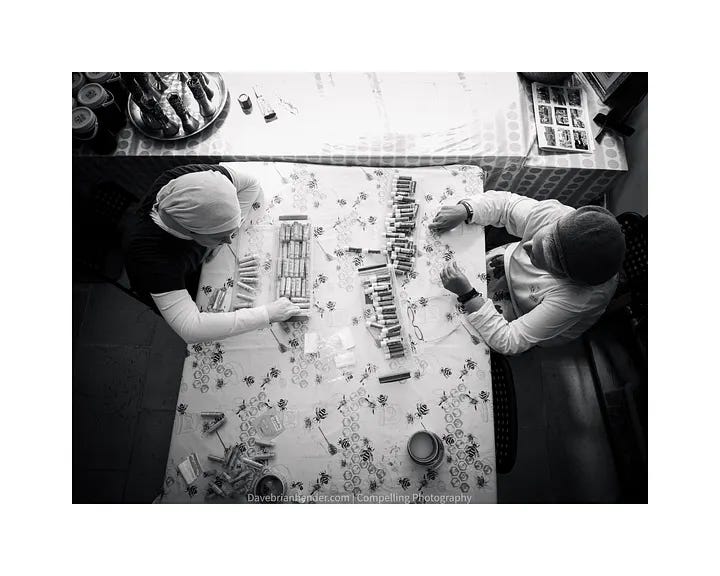
The Harvest
When you drop the color, everything gets quiet.
I’ve been shooting long enough to know that presets—even custom Leica or Hasselblad curves—are just a starting point. The real work is in the manual tweaks: bringing out shadow detail, managing contrast, and pushing a two-dimensional RAW file until you see the actual soul of the person in the frame. Look at Keren holding that tube of balm against the window light. She’s not an assistant; she owns her craft.
Anybody can write a sweet holiday greeting on a card. Building something tangible out of bees, wax, late-day light, and hard work takes time.
You can explore the full collection of handcrafted honey products and lip balms at Neshika.com.
[PS - re Substack's recent “AI text” feature: Yes, I used AI to help structure and draft this narrative. But every observation, every technical choice, every memory, and every editorial decision is entirely mine—crafted through my own exhaustive prompts, my photographs, and my hands-on creative editing across the visual, technical, and narrative frame - DB.]
[A note from the field: this post may be updated or amended as events develop. My sincere thanks to those who follow, comment, and share these dispatches. Your support keeps the lights on and the cats fed while I’m out navigating the dynamic range of the Galilee. Because the standard Stripe plumbing doesn’t reach us here in Israel, I’ve set up a direct alternative for those who wish to support this work. If you’re inclined to help keep the lens focused, you can contribute via PayPal. Much appreciated. — DB]